
Why manganese steel gets harder the more you hit it
It leaves our foundry soft. That is the point — and it is why a manganese hammer survives an engine block when a harder one would not.
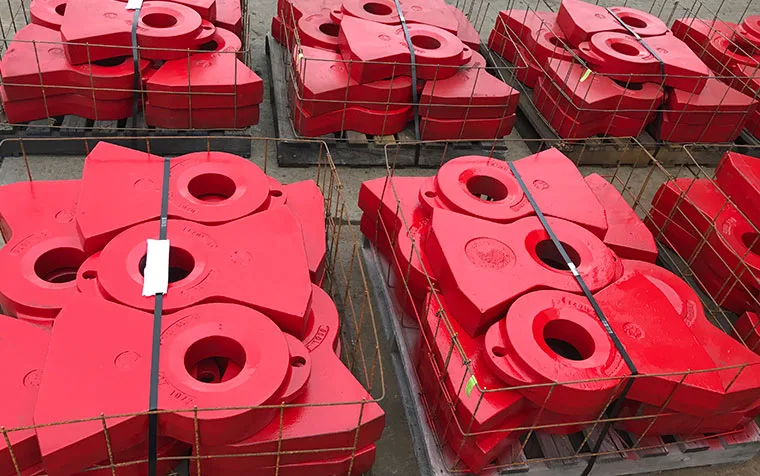
There is a question we get from almost every new customer looking at manganese parts: why is it so soft? A manganese blow bar or shredder hammer arrives at around 200/230 Brinell — roughly 20/21 HRC. Put a file to it and you can mark it. Next to a high chrome bar at 56–61 HRC, it feels like the wrong material entirely.
It isn't. It is a material that does its hardening on your machine rather than in our heat treatment shop.
What happens once it starts working
Under impact, the working face of manganese steel work-hardens. The hardness climbs from that initial 200/230 Brinell up to around 500 Brinell, or 50 HRC. The face that is taking the beating becomes the hard face, and it keeps renewing itself as the part wears.
The hardened layer penetrates to a depth of approximately 10 mm. Everything below that stays as it was cast — and that is the half of the story people miss.
Why that matters in a shredder
An auto shredder hammer takes an uncrushable object on almost every rotation. End-of-life vehicles arrive with engine blocks, axles and drive shafts still in them, and a hammer has no way to be selective about what it hits.
A high chrome hammer at 56–61 HRC has very low impact strength. It would not survive that feed — it would shatter, and probably on the first engine block. Manganese survives because the tough core underneath absorbs what the hard face takes.
The same logic applies to demolition recycling. CDR feed carries rebar and tramp metal, which is why Kleemann Reiner blow bars for that duty are cast in manganese grade 6/7 rather than in chrome.
What changes the numbers
The depth and hardness reached are not fixed. They depend on the application and on the type of manganese steel — we supply both standard and premium grades, and we will match the grade to your feed and to your machine.
One consequence worth knowing: manganese needs impact to harden. In a low-impact, purely abrasive duty it never gets the chance, and it will simply wear. That duty belongs to high chrome instead.
So when do you pick it?
Manganese wear parts are a relatively low-cost option offering good wear life, and are ideally suited for high impact applications where tramp metal or uncrushable objects are included in the feed material. If that sentence describes what goes into your machine, manganese is very likely your grade.
If it does not — if your feed is clean and the enemy is abrasion rather than impact — you want high chrome white iron, and for feed that keeps changing, martensitic steel.
See what we cast in manganese steel →ELV & auto shredder parts →